

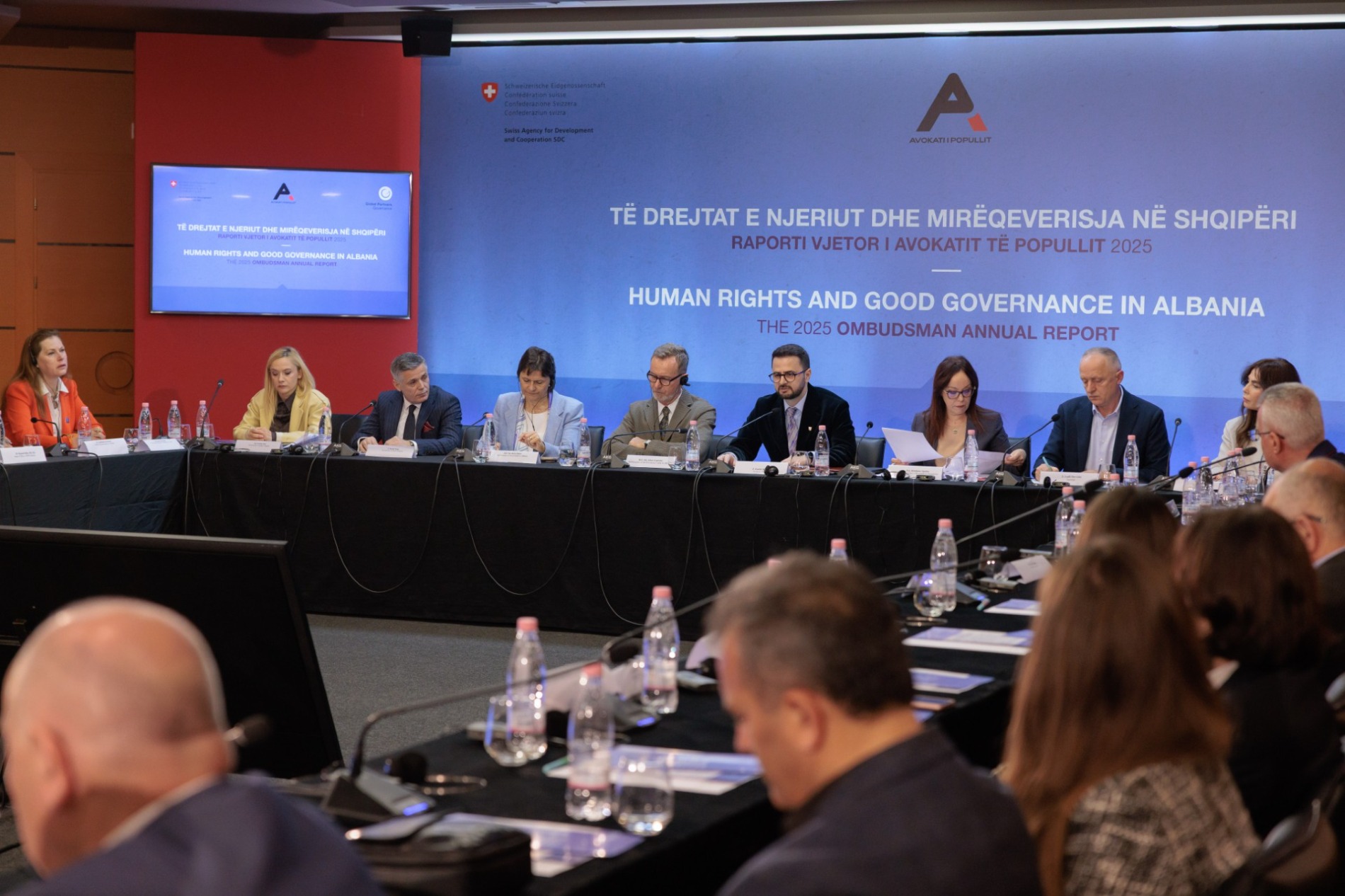
Speech By The Ombudsman, Mr. Endrit Shabani At The Roundtable Discussion Of The Preliminary Findings Of The Ombudsman For The Year 2025
Honorable Vice-President of the Assembly,
Honorable representatives of the highest institutions of justice,
Excellencies Ambassadors and honorable representatives of the diplomatic corps,
Honorable heads and representatives of international missions and organizations,
Honorable colleagues and partners of civil society,
Honorable ladies and gentlemen,
I thank you for your presence today, in this discussion on the annual report of the People’s Advocate.
This document marks a turning point for us. For 25 years, the People’s Advocate’s report has been mainly a balance sheet of our internal work.
This year, we have decided differently. We intend for the report to serve as an annual snapshot of good governance and the real state of human rights in Albania.
Of course, such a report cannot remain simply the voice of a single office. Nor can it be just the voice of those citizens who chose to complain to us. It should—and aims to—be the voice of the entire society.
This is why we have held this event today. We want to give civil society actors the opportunity to provide comments on our findings, as well as to contribute their data from the field.
The goal is for the voice of civil society to become an integral part of the Annual Report of the Ombudsman.
It is worth noting that, thanks to the legal changes of December 2025, this is the first time since the establishment of the Ombudsman institution that the draft report is made public before submission to the Assembly. This meeting clearly demonstrates our vision for full transparency with citizens.
But this new approach requires us to reform not only the form of the reports, but the very essence of the way we function as an institution.
My vision for the next five years is based on five main objectives, with the aim of turning the Ombudsman into a stronger voice for citizens:
First, digital modernization.
To eliminate bureaucratic delays, we are digitizing the entire complaint cycle. From receiving the request to issuing the recommendation, every step will be online. The citizen will see in real time which office is working on his file and what actions have been taken. This increases our transparency and accountability, while simultaneously exerting healthy pressure on the administration itself.
Secondly, recommendations with real impact. The drafters of the Constitution did not conceive of this institution as an archive of documents, but as a guarantor of fundamental freedoms. Therefore, when we speak, things must change. To achieve this, we will build bridges of cooperation with state agencies. However, where we encounter resistance, we will not hesitate to use any legal instrument against any official who violates the rights of citizens.
Thirdly, to be present for every age group and in every corner of the country. For young people, we will speak their language. We will be more active on social networks and will enable complaints through applications. For the needy, postal service to us will be free. We will also open representative offices in the suburbs and in marginalized neighborhoods. Exactly where state forgetfulness is felt most deeply.
Fourth, strengthening civil society. Our vision is for this work to serve you directly. To this end, we are creating analytical tools such as the Good Governance Barometer, the Equality Index and the National Rights Map. These will help you expose abuses of power and measure real progress over the years.
Fifth, increasing public trust. My goal is that the Ombudsman should become the most trustworthy institution in Albania. Being aware that trust is earned, we are building a new communication approach. We will fully open the institution, and we will leave the comfort of our offices to be constantly on the ground, where people are directly confronted with injustices. In parallel, we will be much more present in the media and we will use modern communication formats such as podcasts. We want to speak directly to citizens, so that they see this institution as their ally every time the administration slams a door on them.
This vision requires a joint contribution.
And in fact, I take this opportunity to emphasize the help we have received from the PACEP II project, which is assisting us in our accountable function before the Assembly and the citizens, assisting from the needs assessment to new strategies and the methodology of recommendations. Therefore, on behalf of our institution, I express my gratitude to the Embassy of Switzerland, the Swiss Agency for Development and Cooperation, as well as GPG Albania.
Now let us dwell on the findings of the report.
At a stage where Albania has essential obligations for Chapters 23 and 24 of European integration, we do not want to simply produce a routine document. We want to provide a real scanner of our state's readiness. Approximation of legislation is important, but European standards are not measured by laws on paper. They are measured by the water that is missing in the countryside. By the lack of heating in schools. By court decisions that are ignored and by women who are left without protection.
This draft reflects precisely this reality, divided into five chapters:
The first chapter deals with good governance and accountability.
As Commissioner Erinda Meli will detail later, the highest number of complaints are received in connection with the work of the State Cadastre Agency.
Over 27 thousand final property decisions still remain unregistered. Meanwhile, only a third of the compensation decisions have been executed. We have citizens with full files awaiting compensation for the 2010 floods. This behavior of the administration creates deep legal uncertainty and holds property rights hostage.
At the local level, local government often avoids accountability and fails in its protective functions. The fire that broke out this week in a building in Tirana revealed unprepared local institutions.
Beyond the criminal aspect, which the law does not allow us to intervene in, there is an administrative aspect that holds local government responsible. From the preliminary investigation, we have found problems related to guaranteeing the technical safety of buildings, or problems with planning spaces for firefighters to intervene.
Knowing that this is not an isolated case, the Ombudsman has set up a Task Force. This group is investigating the safety of shared housing in the capital and will come up with concrete legal and administrative recommendations.
Meanwhile, we have asked the Municipality of Tirana to provide immediate housing solutions for the affected residents, through its social housing programs.
Among other things, this case highlighted the need for the Ombudsman to have powers over the private sector to protect consumers, such as the relationship between residents and the builder of the building. We have included this request in the new draft law, and today I take the opportunity to remind the Assembly of this necessity.
The second chapter of the report analyzes political and civil rights.
Commissioner Besnik Deda will introduce you to the findings of 2025, but the essence remains alarming. Our courts are working with only 66% of human capacity. The delays are so extreme that citizens wait on average over 4 years and 3 months for a judicial decision to materialize.
Meanwhile, prisons remain overcrowded; about 57% of prisoners are held there without a final decision. The treatment of minors detained in protests is also extremely worrying, who in some cases have been questioned in police stations without the presence of their parents or psychologists.
The third chapter covers economic and social rights.
As Commissioner Vilma Shurdha will address, although we have good legislation, the challenge is real protection in practice. Here we observe the "paradox of digitalization". Instead of providing convenience, online platforms are becoming an obstacle for the poorest.
The case of a complainant from Vora is illustrative: she lived in misery, but was excluded from economic assistance simply because "the system did not generate enough points". This shows the dark side of the automation of processes and dependence on algorithms.
The fourth chapter touches on equality and the protection of special groups.
Here we find wounds that require emergency intervention. We talk about standards, but during the last elections, only 207 out of over 880 voting centers were accessible to people with disabilities. This becomes even more worrying when we consider that these centers are located in schools. So, it is the schools themselves that do not create conditions for children with disabilities.
For marginalized communities, like the Roma in Baltëz, the lack of drinking water still keeps them in survival conditions.
Above all, gender-based violence and femicide remain grave national wounds. The failure of institutions to implement “protection orders,” turning them into pieces of paper without any real shield for women, is inexcusable.
Finally, the fifth chapter is dedicated to our internal activity. We have left ourselves last, because, as I emphasized at the beginning: at the center of this process are not us, but the citizens we serve.
And in conclusion, I want to emphasize that this draft report that we will share today is a snapshot of the reality of the year we left behind.
If we do not like this snapshot, each of us must contribute according to our ability. We cannot do it alone.
We expect the Assembly to hold accountable, also through interpellations, public institutions that abuse public power.
We ask international partners to see this material as a guide on where foreign assistance should be focused.
As for my colleagues in civil society, I have three questions, the answers to which I expect to hear in the second part of this activity.
- First, do our findings match what you encounter every day in the field?
- Second, are there any issues that you do not find included in our draft report yet?
- And third, which of these issues should we make a priority of our joint work, so that we can jointly hold institutions accountable during this year?